Losing one or more teeth is more common than most people think, and it's rarely just a cosmetic issue. It affects how you chew, how you speak, and honestly, how confident you feel when you smile at someone. If you've started researching ways to replace missing teeth, chances are you've already run into two names over and over again: dental implants and dentures.
Both work. Both have been helping people for decades. But they are not interchangeable, and the "right" choice depends on your mouth, your budget, your lifestyle, and even your patience for the process. At True Dental, we get asked about this comparison almost every week, so we put together a straightforward, no-jargon breakdown to help you figure out which path makes sense for you.
What Are Dental Implants?
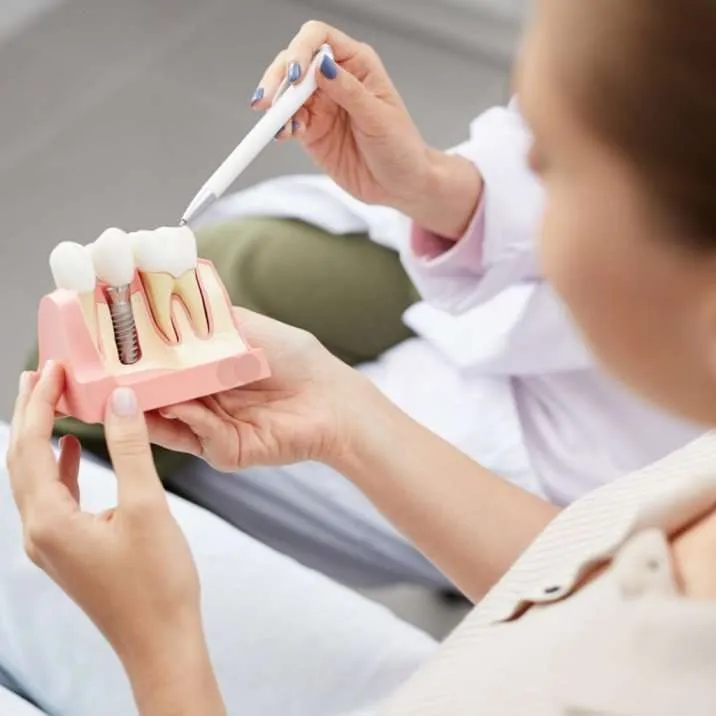
A dental implant is a small titanium post that's surgically placed into your jawbone, acting as an artificial tooth root. Once it fuses with the bone (a process called osseointegration), a custom crown is attached on top. The result looks, feels, and functions almost exactly like a natural tooth.
Implants can replace a single tooth, several teeth, or even a full arch using options like implant-supported bridges or All-on-4 systems. Because the implant is anchored directly into the bone, it doesn't rely on the surrounding teeth or gums for support the way other solutions do.
What Are Dentures?
Dentures are removable prosthetic teeth designed to replace missing teeth and surrounding tissue. They come in two main types:
-
Complete dentures – used when all teeth in an arch are missing
-
Partial dentures – used when some natural teeth remain
Dentures rest on the gums and are held in place with suction, adhesive, or clasps that attach to nearby teeth. They're removable, which means you take them out at night for cleaning and to let your gums rest.
Dental Implants vs. Dentures: Key Differences
1. Stability and Comfort
This is usually the biggest deciding factor. Dental implants are fixed permanently in the jaw, so there's no slipping, shifting, or clicking when you talk or eat. Dentures, on the other hand, sit on top of the gums and can move slightly, especially during meals or over time as the jawbone changes shape.
Many patients who switch from dentures to implants tell us the same thing: they simply forget the implant is there. That level of comfort is hard to match with a removable appliance.
2. Bone Health
Here's something a lot of people don't realize until later: your jawbone needs stimulation to stay strong, and tooth roots normally provide that stimulation. When teeth are missing, the bone gradually shrinks, a process known as bone resorption.
Dental implants mimic a natural tooth root, so they help preserve jawbone density. Dentures don't offer this benefit, and over the years, the jaw can change shape enough that dentures need to be relined or replaced entirely.
3. Chewing Efficiency
Implants restore close to 90-100% of natural biting force, which means you can eat steak, apples, nuts, and other firm foods without worrying. Dentures typically restore only 20-40% of natural chewing strength, so many denture wearers avoid harder or chewier foods altogether.
4. Maintenance and Daily Routine
Dentures require daily removal, cleaning, and soaking overnight, plus occasional adjustments as your gums change. Implants are cared for just like natural teeth: brushing, flossing, and regular dental visits. There's no extra routine to learn.
5. Longevity
With good care, dental implants can last 20-25 years or even a lifetime. Dentures generally need replacement or relining every 5-8 years due to normal wear and changes in gum and bone shape.
6. Cost and Time Investment
This is where dentures often win, at least upfront. Dentures are less expensive initially and can be completed faster, sometimes within a few weeks. Implants involve a higher upfront cost and a longer treatment timeline, often several months, because the implant needs time to fuse with the bone before the crown is placed.
That said, when you factor in replacements, relines, and adhesives over the years, dentures can end up costing a similar amount over a lifetime, just spread out differently.
Who Should Consider Dental Implants?
Implants tend to be the better fit if you:
-
Have enough healthy jawbone (or are open to bone grafting)
-
Want a permanent, low-maintenance solution
-
Are missing one or a few teeth
-
Prioritize chewing strength and natural feel
-
Are in good general health with no conditions that slow healing
Who Should Consider Dentures?
Dentures may be the more practical choice if you:
-
Need to replace all or most of your teeth
-
Are looking for a lower upfront cost
-
Prefer a non-surgical option
-
Have significant bone loss that makes implants difficult without extensive grafting
-
Want a quicker turnaround time
Is There a Middle Ground?
Yes, actually. Implant-supported dentures combine both worlds. A small number of implants are placed in the jaw, and a denture snaps securely onto them. This gives you much better stability than traditional dentures without the cost of a full set of individual implants. It's a popular option for patients who want more security but aren't ready for (or don't need) a full implant for every tooth.
Making the Right Choice for You
There's no universal "better" option here, only what's better for your mouth, your health, and your goals. Someone with healthy bone density and a couple of missing teeth will usually get more long-term value from implants. Someone missing most of their teeth, working with a tighter budget, or dealing with bone loss might find dentures, or implant-supported dentures, to be the smarter path.
The only way to know for sure is a proper evaluation, X-rays, a look at your bone structure, and an honest conversation about your lifestyle and budget.
Ready to Find Out Which Option Fits You?
At True Dental, we walk every patient through both options honestly, no upselling, just real guidance based on your specific situation. If you're ready to stop guessing and get a clear answer, schedule a consultation with our team today, and we'll help you find the option that lets you eat, speak, and smile with confidence again.